(no subject)
Apr. 6th, 2006 12:40 am![[personal profile]](https://www.dreamwidth.org/img/silk/identity/user.png) lapsedmodernist
lapsedmodernistI have been showing the "Going Tribal" episodes in both of my classes. The "mature audiences" warning at the beginning of the program says: contains indigenous nudity. And that is pretty much my dissertation, summed up in three words. Or, as a guy who once tried to pick me up at Irene's in Greenpoint, slurred drunkenly (upon finding out I was studying anthropology): "uhh, so what I wanna know [hiccup] is...how come if it's a white woman's breasts it's pornography, but it it's a native woman's breasts it's anthropology?"

Seriously, I can't deal with "Going Tribal," I can't deal with the metacolonial humor of the hapless viewer-proxy Brtishman who is so earnest and makes faces when he realizes that he has to drink an entire pitcher of cow blood. "It's like a nutricious shake...it's not pleasant, but it's not disgusting...oh, you want me to drink the whole thing? Oh-ho-ho. [sotto voice] When I said it wasn't disgusting that was because I had only had a little bit." I also can't deal with the Discovery Channel screen captions that say "how far would you go to unleash your inner native? Bruce Parry is Going Tribal."
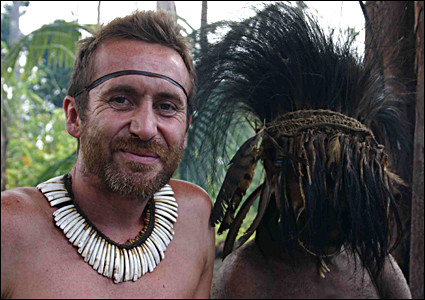
Bruce Parry, the specter of colonialism.
The thing about this show, is it is "ethnographic" in the same way that the World Fairs were, and (in a more "subtle") fashion, National Geographic. They all create spaces for the Western viewer/consumer to alleviate his colonial/postcolonial anxiety about other cultures/races/ethnicities. And they all provide the same re-iterated model of The West relating to The Rest through the lens of its own fantasy. The specifics of the fantasy vary with the time period. So, at the beginning of the 20th century you had natives imported for World Fairs and into the semiotic discourse of "descent of man" evolutionary diagrams, where white = upright. In 1960s National Geographic quietly did away with the images of white travellers in colonial territories being serviced by the native people because such images in the real world were becoming metonymic with struggles for independence and the volatile tensions as colonialism was imploding and ushered in quotas for Brown People vs. Bronze People vs. White People images (28%, 60% and 12%, respectively, in case you are curious). And now you've got the retro-colonial fantasy looping in on itself as the demand for "the primitive" produces a supply of "the primitive," which provides building blocks and narrative elements for the syncretic, confused mess that is the cosmology of that person next to you in your yoga class, with a "tribal" tattoo, who likes to say things like "in South America* there is a tribe** where [insert Western fantasy about the pastoral Eden lost to industrialization and capitalism]." Not to mention about how the idea of a "tribe" is itself more-or-less a colonial institution.
***
In totally unrelated news, I finally saw Brokeback Mountain and something about the dynamic between Heath Ledger and Jake Gyllenhaal and the minimalist affect up until the very end where there is mortality/emotion baroque apex reminded me of James Baldwin's Giovanni's Room. I guess it depends on how you read Giovanni's Room: do you read it as a novel about the alienation of modernism, told through the narrative of a gay love affair conducted in a social context that alienated the lover from his love...or do you read it as a tragedy of sub-articulated, repressed love that is structured as a modernist tale of alienation? Which side do you want to be a Lucacs for, what's the real base and what's the allegory? Like, Giovanni's Room was about people who couldn't love, not in a Bret Easton Ellis sociopathy, sort of way, but in a modernist alienation sort of way. And since I don't understand love as an abstract, and believe in it only as it is enacted through the syntax and lexicon of shared meaningful symbols, I kept thinking that the characters in the movie were alienated from love, without the language and social space to articulate it and enact it. This is not forbidden love. This is something that I identify as love because I am afforded the vocabulary to do so, but at the time the semiotic units available through their shared community only arranged themselves to spell "pathology" or "nasty."
* Sometimes it's Africa
** the "tribe" is never named
Seriously, I can't deal with "Going Tribal," I can't deal with the metacolonial humor of the hapless viewer-proxy Brtishman who is so earnest and makes faces when he realizes that he has to drink an entire pitcher of cow blood. "It's like a nutricious shake...it's not pleasant, but it's not disgusting...oh, you want me to drink the whole thing? Oh-ho-ho. [sotto voice] When I said it wasn't disgusting that was because I had only had a little bit." I also can't deal with the Discovery Channel screen captions that say "how far would you go to unleash your inner native? Bruce Parry is Going Tribal."
Bruce Parry, the specter of colonialism.
The thing about this show, is it is "ethnographic" in the same way that the World Fairs were, and (in a more "subtle") fashion, National Geographic. They all create spaces for the Western viewer/consumer to alleviate his colonial/postcolonial anxiety about other cultures/races/ethnicities. And they all provide the same re-iterated model of The West relating to The Rest through the lens of its own fantasy. The specifics of the fantasy vary with the time period. So, at the beginning of the 20th century you had natives imported for World Fairs and into the semiotic discourse of "descent of man" evolutionary diagrams, where white = upright. In 1960s National Geographic quietly did away with the images of white travellers in colonial territories being serviced by the native people because such images in the real world were becoming metonymic with struggles for independence and the volatile tensions as colonialism was imploding and ushered in quotas for Brown People vs. Bronze People vs. White People images (28%, 60% and 12%, respectively, in case you are curious). And now you've got the retro-colonial fantasy looping in on itself as the demand for "the primitive" produces a supply of "the primitive," which provides building blocks and narrative elements for the syncretic, confused mess that is the cosmology of that person next to you in your yoga class, with a "tribal" tattoo, who likes to say things like "in South America
***
In totally unrelated news, I finally saw Brokeback Mountain and something about the dynamic between Heath Ledger and Jake Gyllenhaal and the minimalist affect up until the very end where there is mortality/emotion baroque apex reminded me of James Baldwin's Giovanni's Room. I guess it depends on how you read Giovanni's Room: do you read it as a novel about the alienation of modernism, told through the narrative of a gay love affair conducted in a social context that alienated the lover from his love...or do you read it as a tragedy of sub-articulated, repressed love that is structured as a modernist tale of alienation? Which side do you want to be a Lucacs for, what's the real base and what's the allegory? Like, Giovanni's Room was about people who couldn't love, not in a Bret Easton Ellis sociopathy, sort of way, but in a modernist alienation sort of way. And since I don't understand love as an abstract, and believe in it only as it is enacted through the syntax and lexicon of shared meaningful symbols, I kept thinking that the characters in the movie were alienated from love, without the language and social space to articulate it and enact it. This is not forbidden love. This is something that I identify as love because I am afforded the vocabulary to do so, but at the time the semiotic units available through their shared community only arranged themselves to spell "pathology" or "nasty."


![[identity profile]](https://www.dreamwidth.org/img/silk/identity/openid.png)
no subject
Date: 2006-04-06 05:08 am (UTC)2. When I first read this I thought you had written/that the titles said "ingenious nudity." Sorry, but that would have been so much more interesting! (Not for you to write about, but a warning for ingenious nudity?!)
3. Have you listened to the TAL episode in which the guy proposes "philanthropy tourism"? We might have actually discussed it, I'm not sure. But if you haven't, I think you'd be into it in one way or another.
http://www.thislife.org/pages/descriptions/05/302.html
no subject
Date: 2006-04-06 05:11 am (UTC)Un-fucking-real. How can anyone write that in the 21st century without benefit of a megadose of irony?
how come if it's a white woman's breasts it's pornography, but it it's a native woman's breasts it's anthropology?
My answer is still the same as the one I gave over coffee: presumably the white women get paid.
no subject
Date: 2006-04-06 05:40 am (UTC)no subject
Date: 2006-04-06 08:45 am (UTC)Love your comment on Brokeback Mountain. There was a call for papers recently for a book about the film (already!) and I am vaguely thinking about writing something about the difference between queer films and gay films for it, but they want full articles rather than abstracts in about a month's time, so I probably don't have time.
no subject
Date: 2006-04-06 03:46 pm (UTC)I can see how equating 100 people in an individual village with, for example, the Gauls, would be misleading though. Is this what you had in mind?
no subject
Date: 2006-04-06 08:56 pm (UTC)no subject
Date: 2006-04-06 08:56 pm (UTC)no subject
Date: 2006-04-07 12:57 am (UTC)Or is it the social structure of the tribes you argue against, not the presence of tribes par se? I really don't see quite what you mean.
Besides, I thought the british colonial method was to find a minority, put them in charge, and then let their continued survival be dependent on british guns. Worked quite well while the brits were still around, IIUIC, although it left quite a mess when they left.
no subject
Date: 2006-04-08 03:24 pm (UTC)Like, when the colonial administrators did census counts they marked people as Tutsi or Hutu, which had been a largely class distinction, and they recreated that division as a "different tribes" discourse, using their own social Darwinist theories to reify the superiority of the Tutsis over the Hutus (b/c they considered Tutsis to be Hamites, i.e. closer in descent to white Europeans). After the independence this led to the now-empowered Hutus considering the Tutsis as a tribe of infiltrators and foreign invaders (historically) and this was eventually turned into the propaganda that fueled the genocide.
no subject
Date: 2006-04-08 04:50 pm (UTC)I guess this is compatible with an argument that the colonialists re-established tribal distinctions that were more or less defunct, but they didn't invent them out of thin air. Seemingly, the tutsi/hutu distinction was significantly more pronounced in 1900 than, say, normands/saxons were in 1500.
Rwanda aside, how does this translate to south america? Neither the portugese or the spanish seemed particularly interested in establishing local rulerships, so why would they invent tribal distinctions?
no subject
Date: 2006-04-06 11:57 am (UTC)no subject
Date: 2006-04-06 01:42 pm (UTC)no subject
Date: 2006-04-06 01:48 pm (UTC)no subject
Date: 2006-04-06 04:21 pm (UTC)no subject
Date: 2006-04-06 04:33 pm (UTC)no subject
Date: 2006-04-06 06:08 pm (UTC)no subject
Date: 2006-04-07 03:57 am (UTC)