Colonial Nostalgia
May. 23rd, 2004 01:36 am![[personal profile]](https://www.dreamwidth.org/img/silk/identity/user.png) lapsedmodernist
lapsedmodernistI am working up to a long post.
In the meantime, I have some thoughts.
1. Colonial Williamsburg should be merged with Williamsburg, Brooklyn. I realize that it would pose a challenge practically, but irony trumps geography.
2. This just might become my New Exciting Obsession.
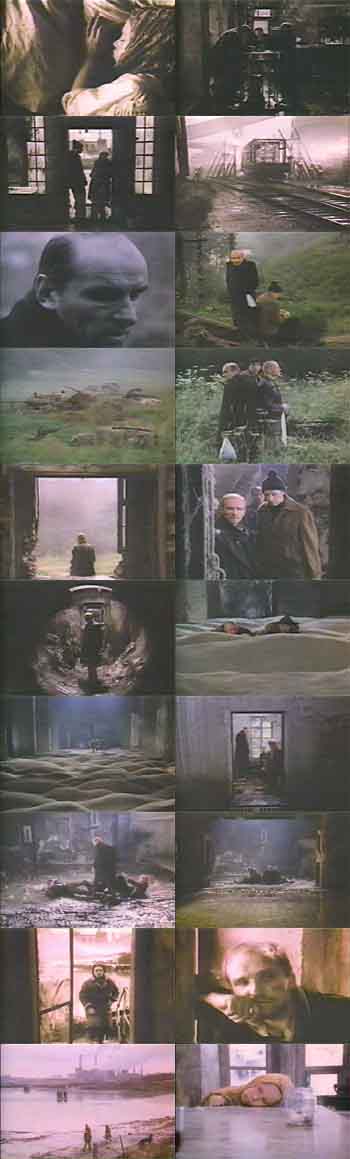
3. Tarkovsky's art flick Stalker was adapted from a novel by the Soviet sci-fi dynamic duo, Brothers Strugatsky. The novel was called Picnic by the Roadside and took place in and around the Zone, which was off-limits and unpopulated, but access could be gained by employing stalkers, who, like borderlands coyotes knew the ins, the outs, and the dangerous pockets, if not the origin or purpose of the Zone. The Zone, invented by the writers and depicted by Tarkovsky in bursts of chromatic shifts, retrospectively reads like a foreshadowing for the Exclusion Zone of Chernobyl that spans miles and has its own stalker, equipped with a motorbike and a camera.
4. High Five!
In the meantime, I have some thoughts.
1. Colonial Williamsburg should be merged with Williamsburg, Brooklyn. I realize that it would pose a challenge practically, but irony trumps geography.
2. This just might become my New Exciting Obsession.
3. Tarkovsky's art flick Stalker was adapted from a novel by the Soviet sci-fi dynamic duo, Brothers Strugatsky. The novel was called Picnic by the Roadside and took place in and around the Zone, which was off-limits and unpopulated, but access could be gained by employing stalkers, who, like borderlands coyotes knew the ins, the outs, and the dangerous pockets, if not the origin or purpose of the Zone. The Zone, invented by the writers and depicted by Tarkovsky in bursts of chromatic shifts, retrospectively reads like a foreshadowing for the Exclusion Zone of Chernobyl that spans miles and has its own stalker, equipped with a motorbike and a camera.
4. High Five!


![[identity profile]](https://www.dreamwidth.org/img/silk/identity/openid.png)
no subject
Date: 2004-05-23 10:57 am (UTC)But anyway, both are equally ridiculous/specific sites to behold in someways. The costumes, the people hanging out of the street, the lack of children (I guess it would illegal to employ children to work as 17th c. children there so they have none), the tourist potential for both sites -- you know -- "see local artisans making things" -- there are a lot of parallels. I think at some point some friends and I were trying to figure out how we could set up an exchange program. Then we were joking about tourists booking vacations to the "wrong" Williamsburg, and how funny that would be in both directions.
no subject
Date: 2004-05-23 09:56 pm (UTC)I think an exchange program is a fabulous idea. Two diverted tour busses...Wackiness ensues. It's like a movie with the Olson twins.
no subject
Date: 2004-05-24 11:30 am (UTC)no subject
Date: 2004-05-23 04:29 pm (UTC)just curious, have you actually seen Tarkovsky’s Stalker or were you just making a comment of its origins? It is one of my favorite films of all times, although my opinion differs quite a bit from most in that I happen to think that Stalker’s wife—though secondary in the plot—really is the central character of the premise.
no subject
Date: 2004-05-23 09:52 pm (UTC)I grew up in Moscow; I am kind of fascinated with all aspects of the atomic age and how it happened in very different ways in the US and USSR, as I
wank about
on lj sometimes.
Disconnected thoughts, and probably too many of them.
Date: 2004-05-24 11:29 am (UTC)I like the comment of about the wife being the central character of the premise, even though I don't really think that the premise (as I understand it) really allows for a central character... the central character seems to me to be life itself and that question, the questions that shape our relationship to the Zone. Or that shape the relationships of the various characters to the Zone. Where do we really LIVE? The wife provides an interesting foil to the quest of the writer, the scientist, the stalker... she insists on living in something that I think many refer to as "the everyday". The rest of them miss the opportunities of that, dreaming of something better, wishing to go somewhere else, somewhere elusive to find something deeper. But then, she seems to miss something too in wanting to exclude the possibilities of Zone from her everyday.
Admittedly, lurking underneath my insistence that no character in that film is really more essential to the premise is a sometimes-surfacing feeling that Monkey is the most central character. Her very being poses a profound question about the definition of the everyday that the wife insists upon and the sanctity of the Zone that the Stalker is committed to guiding people through. Must we understand these realms as mutually exclusive? What happens in the final scene, what is going on between Monkey, the moving furniture, the passing train and the possibility of a deeply affecting, enchanting everyday? I love that scene because it depicts an event through which the mystical and the everyday incorporate and generate each other.
It's kind of a funny question, maybe about the character with which you identify your vision of a beautiful life, or with which you identify your most pressing concern. Although it's a different question, I guess, trying to sort out which character we think Tarkovsky identifies as the protagonist of his vision. He is so subtle and sensitive! I have heard people accuse him of misogyny.
Another thing I was thinking of is that the film inevitably freezes the relationships of the various characters to the Zone and to "everyday life." The characters are, in many ways, archetypes. What is amazing about living a life and living out the loves of your life (family, lovers, friends, colleagues, etc.) is that our relationships to and conceptions of these questions are (or can be) dynamic. We are not, or we needn't be archetypes.
Re: Disconnected thoughts, and probably too many of them.
Date: 2004-05-24 10:50 pm (UTC)the mystical and the everyday incorporate and generate each other.
I think that is very true. Again, like I mentioned above, I have a hard time thinking of the film as separate from the book it was based on, especially since the authors of the book adapted it for the film. The film is very philosophical and abstract and the novel is a lot more gritty, situated and dystopian, so for me the aspect of the novel that is a critique of the communist "paradise" carries over to the film (there is a "zone" that is an experiement of sorts, at the center of it is supposedly a key to happinness but it's impossible to get to and people have to travel the path to it according to the rules they don't fully understand; furthermore what the room REALLY actualizes is what's in the heart of the beholder, and if the heart's deepest wish is not what one would hope it would be, well, the road to hell is paved with good intentions, as we learn from the story of the dead Stalker, Porcupine). For me, insofar as there is the main character it's the Stalker himself, as an everyman. The wife and Monkey are Context, and I capitalized it because Context is completely formative to a character in such a narrative, not agency. The narrative postulates that the room (in the book it's the golden ball in the room) will fulfill the deepest desire of one's soul, and at the very end the Stalker cannot bring himself to articulate a conscious wish, and can only utter a prayer, a hope, a belief that his unconscious desire is pure:
"The sun simmered and red spots swam in front of his eyes, the low air was shaking, and in this fractured air it seemed that the ball was dancing in place, like a bouy atop the waves. He walked past the water, supersticiously lifting his legs so as not to step into the black spills, and then, sinking into the soft ground, dragged himself diagonally across the ravine to the dancing and winking ball. He was covered in sweat, choking from the heat, and at the same time a chill stitched through him, he shook, as if hung over, and dry chalky dust sqeaked between his theeth. And he wasn't trying to think anymore. He just repeated in his mind, desperately, like a prayer: "I am an animal, you see, I am an animal I have no words, I wasn't taught words, I don't know how to think, those bastards didn't let me learn how to think. But if you are really like taht...almighty, ubiquitous, understanding, figure it out! Look into my soul, I know everything you need is there. It has to be. Because I never sold my soul. It's mine, it's human. Extract it from me, what I want--it can't be that I would want something bad. All be damned, I can't think of anything, except these words--HAPPINESS FOR EVERYONE, FOR FREE, AND LET NO ONE LEAVE SHORTCHANGED."
So that's how the book ends, and while a text is a text and it circulates independetly of the intentions of the author, but for me, having first watched it in the country it was made in, knowing that the authors of the book adapted their vision for the movie, knowing that their audience would be familiar with the book (which was incredibly popular, as was all of their work, they were among the most published and prolific Soviet writers of the last 50 years), I can't help but read the book into the film and it colors my interpretation and I just wanted to share a little piece of it.
Re: Disconnected thoughts, and probably too many of them.
Date: 2004-05-25 05:23 pm (UTC)I agree that the Porcupine story is really the centerpiece. It's all I could remember, it overwhelmed my experience of that film. Have you seen Andrei Rublev? The part that stands out for me is the moment when the little boy reveals to rublev that his father the bellmaker never taught him, but the bell is still ringing out. Pure magic.
I've really loved hearing your take on this, I want to go watch Stalker again now...
Thanks, Erin
Re: Disconnected thoughts, and probably too many of them.
Date: 2004-05-25 07:21 pm (UTC)Picnic was translated into English as Roadside Picnic in the late 70s. Here's a link to a little article about the book, it has all the publishing information at the end. It's out of print, but you can probably easily find it at a library. Our school library has a bunch of their books.
http://www.geocities.com/Area51/Rampart/2547/skyb.htm
no subject
Date: 2004-05-23 09:41 pm (UTC)no subject
Date: 2004-05-23 09:55 pm (UTC)no subject
Date: 2004-05-28 10:58 pm (UTC)